One of the hardest things for builders is not coming up with new ideas.
It is saying no to them.
When you are a software developer or someone who enjoys building products, ideas are everywhere. Every conversation becomes a potential startup. Every inconvenience looks like a business opportunity. Every new technology opens another rabbit hole that convinces you that this might be the one.
For the better part of the last two years, I have lived in that world.
I have built products because I wanted to learn. I built products because I wanted to experiment. I built products because I believed that eventually one of them would become a sustainable business.
That approach served its purpose.
But there comes a point where building stops being the bottleneck.
Execution becomes the bottleneck.
As I promised in my previous update, July was going to be the month where I finally decided which products deserve my attention for the foreseeable future. That decision has now been made.
I am not building anything new.
Not until these products either prove they are unnecessary in the market or become sustainable businesses on their own.
That is the commitment.
Looking Back
Back in December 2024, I wrote a blog titled “Reflections on 2024: Staying the Course and Planning for 2025.”
In that article, I identified three businesses that I believed had the highest potential.
Interestingly, after nearly two years of building, experimenting, launching, failing and learning, those businesses are still here.
Many other ideas have come and gone.
Some turned into working products.
Others never found their footing.
A few simply taught me lessons I could not have learned any other way.
What surprised me is not that some products failed.
What surprised me is how much clarity only comes after you have actually built something.
There is no spreadsheet in the world that can replace putting a product in front of real people.
The Problem with Having Too Many Products
People often ask me,
“How many products are you currently working on?”
The truthful answer has always been…
Too many.
Throughout 2025 I challenged myself to build twelve products.
That challenge achieved exactly what I hoped it would.
I became a significantly better product builder.
I learned more about user experience, marketing, sales, customer onboarding, infrastructure, pricing, positioning and product management than I would have by simply reading books.
But there was one unintended consequence.
Attention became fragmented.
Every product required marketing.
Every product required customer support.
Every product needed bug fixes.
Every product wanted new features.
Every product needed documentation.
And unfortunately, every product believed it deserved to be the priority.
The reality is that a single founder only has so many hours in a day.
Eventually something has to give.
Scoring Every Product
Rather than relying on emotions, I decided to score every startup against the same criteria.
The categories were simple:
- Dedicated co-founder
- MVP readiness
- Revenue potential within the next few months
- Contribution to the wider ecosystem
- Innovation
- Scalability
- Ease of execution
- Market demand
- Personal excitement
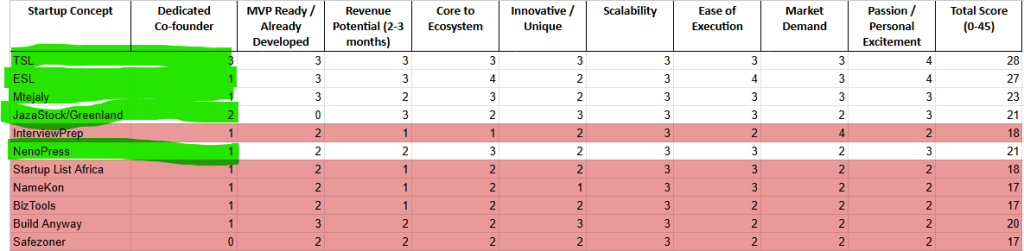
The exercise was incredibly useful because it forced me to separate what I enjoyed building from what actually makes business sense.
Some products scored surprisingly high.
Others scored lower than I expected.
That doesn’t necessarily mean they are bad businesses.
It simply means they are not the right businesses for me to focus on right now.
One realization became obvious almost immediately.
The highest scoring products were also the ones that naturally complemented each other.
That mattered more than I initially expected.
Why Only Five Products Remain
After reviewing everything, I decided that only five products will receive my full attention going forward.
Those are:
- To Somewhere Logistics (TSL)
- Eliday Solutions Ltd (ESL)
- Mtejaly
- NenoPress
- JazaStock (formerly Greenland Commodities)
Everything else goes into maintenance mode.
Not deleted.
Not abandoned.
Simply not actively developed.
That distinction is important.
A product doesn’t need continuous feature releases to remain alive.
Sometimes it simply needs time.
Building an Ecosystem Instead of Independent Products
One lesson I have learned over the last year is that products become significantly stronger when they support each other.
Instead of trying to build ten completely independent companies, I would rather build an ecosystem where each business makes the others stronger.
That is exactly what these five products achieve.
Eliday Solutions Ltd
ESL becomes the technology company.
It develops software.
It provides AI readiness services.
It offers cybersecurity consulting.
It builds digital products.
Most importantly, it becomes the engineering backbone behind the rest of the businesses.
Instead of outsourcing development, the ecosystem builds its own technology.
Mtejaly
Sales remains one of the biggest challenges for almost every startup.
That is where Mtejaly comes in.
Originally built as a Google Maps lead generation platform, I increasingly see it becoming the sales engine behind every business in this ecosystem.
Whether I am selling logistics services…
Cybersecurity consulting…
Website development…
Or wholesale food supplies…
The first challenge is always the same.
Finding qualified prospects.
Mtejaly solves that problem.
Instead of every business searching for leads independently, they all leverage the same sales platform.
NenoPress
Building a product is only half the work.
The other half is convincing people it exists.
That is where NenoPress fits.
Rather than treating content marketing as an afterthought, NenoPress becomes the publishing arm of the ecosystem.
Articles.
SEO.
Product documentation.
Case studies.
Guides.
Newsletters.
Social media.
Instead of every startup trying to create its own marketing machine from scratch, they all benefit from a shared content strategy.
Marketing becomes an asset instead of an expense.
To Somewhere Logistics (TSL)
TSL remains one of the businesses I am most excited about.
The logistics industry across Africa still has enormous inefficiencies.
Drivers struggle to find loads.
Clients struggle to find reliable transport.
Vehicle owners struggle with utilization.
There is still significant work ahead before TSL reaches the scale I envision, but I continue believing this is one of the highest-impact businesses I can build.
The opportunity remains enormous.
JazaStock
Many people knew this project as Greenland Commodities.
Today it becomes JazaStock.
The idea is evolving beyond simply selling cereals.
The long-term vision is building technology around commodity distribution and supply.
Interestingly, JazaStock naturally benefits from TSL.
Once products need to move from suppliers to customers, transport becomes part of the value chain.
Instead of relying on external logistics providers, TSL can facilitate that movement.
Two businesses strengthen each other.
That is exactly the kind of synergy I want to create.
What About the Other Products?
One question I expect people will ask is…
“What happens to the other startups?”
Nothing dramatic.
InterviewPrep still exists.
Startup List Africa still exists.
BizTools still exists.
Build Anyway still exists.
NameKon still exists.
They simply stop competing for my attention every single day.
If market conditions change…
If a co-founder joins…
If customer demand significantly increases…
I can always return to them.
But for now, they remain stable while my energy goes elsewhere.
Focus requires trade-offs.
Saying Goodbye to SafeZoner
One product deserves its own section.
SafeZoner.
I first introduced SafeZoner during the August/September 2025 update.
At the time, I genuinely believed it had the potential to become something meaningful.
We built.
We tested.
We learned.
Unfortunately, not every startup challenge is technical.
Sometimes partnerships simply do not work out.
After much consideration, my business partner and I decided to part ways.
As a result, I have officially stepped away from SafeZoner.
There is no dramatic story.
No public disagreement.
No blame.
Just two people whose paths eventually diverged.
That happens more often than many founders admit.
While it is disappointing, I do not regret working on the project.
It taught me valuable lessons about browser security, cybersecurity products, partnerships and product development.
Every startup teaches something.
Even the ones you leave behind.
Perhaps one day I will tell the full story.
For now, I am simply grateful for what the experience taught me.
The Remaining Five Months
Time suddenly feels very different.
There are only about five months left before 2026 comes to an end.
When the year started, my objective was straightforward.
Commercialize the products I built during 2025.
I have made progress.
Some products are generating revenue.
Others have registered customers.
Some have validated demand.
Others still require significant work.
But I don’t think I have reached the level I originally envisioned.
Not yet.
The next five months are therefore less about launching.
They are about growing.
Revenue.
Customers.
Partnerships.
Distribution.
Operations.
Processes.
Repeatability.
Those are the metrics that matter now.
Shipping another MVP would simply distract me.
Learning to Finish
I think one of the biggest lessons this journey has taught me is the importance of finishing.
Starting projects is exciting.
Everyone celebrates new beginnings.
Very few people celebrate consistent execution.
Yet that is where businesses are actually built.
Showing up every day.
Improving onboarding.
Talking to customers.
Fixing bugs.
Writing documentation.
Making sales calls.
Following up.
Repeating the process.
Those activities rarely make exciting LinkedIn posts.
But they are exactly what separates products from businesses.
I want to become someone who finishes.
Someone who turns software into companies.
That requires focus.
A Different Definition of Success
Earlier in my journey, I measured success by the number of products I had built.
Today I measure success differently.
How many products have paying customers?
How many customers return?
How many businesses can operate without depending entirely on me?
How many generate consistent monthly revenue?
Those questions matter much more.
The builder in me will always want to create something new.
The entrepreneur in me knows that sustainable businesses are built through repetition, patience and discipline.
This season requires more entrepreneurship than engineering.
Thank You
If you have been following this series from the beginning, thank you.
Some of you have read every monthly update.
Some discovered the series only recently.
Either way, I genuinely appreciate you taking the time to follow along.
One of the reasons I continue writing these updates is accountability.
It is much harder to convince yourself that you are making progress when your journey is documented publicly every single month.
Writing forces reflection.
Reflection creates clarity.
And clarity leads to better decisions.
If you are new here, I encourage you to read the earlier entries in the Journey to Profitable Building series. They provide the full context behind the experiments, the wins, the failures and the lessons that have shaped this journey.
As always, thank you for reading.
Now comes the difficult part.
Less building.
More selling.
Less experimenting.
More execution.
By the time December 2026 arrives, I hope these five businesses will not simply exist.
I hope they will be generating meaningful revenue, serving real customers and proving that focused execution beats endless ideas.
Let’s see what the next five months have in store.
